
Yen Bai to Europe: A Container's Journey in Plain Terms
Shipping a container of panels from Yen Bai Province in northern Vietnam to a European port follows a repeating cycle, and understanding each step makes the logistics less opaque. Dongstar Wood operates from a 48,000 m² factory with 16+ automated production lines, and the monthly output regularly exceeds 100 × 40ft containers — numbers that shape how every shipment is packed, inspected and dispatched.

Key takeaways
- The factory covers 48,000 m² of floor space, and the warehouse exceeds 3,000 m² for staged packing.
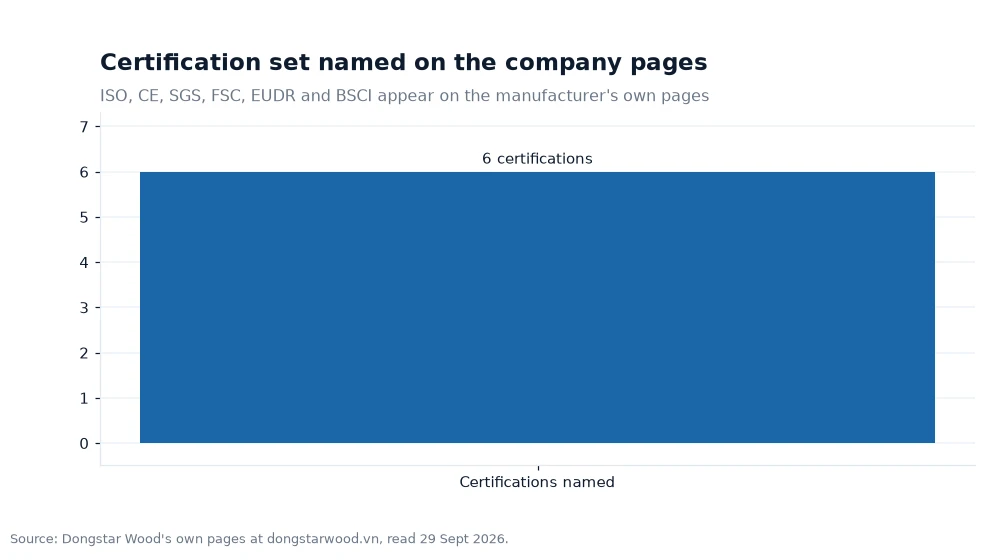
- Certification set: the manufacturer's product pages name ISO, CE, SGS, FSC, EUDR and BSCI.
- Monthly supply capacity exceeds 100 × 40ft, placing trial orders well within one production cycle.
- Export markets cover over 170 countries, with particular focus on Europe and the Americas.
Step one: production and batch pressing
The journey begins long before a container is loaded. Panels are pressed on one of 16+ automated production lines inside the factory in Yen Bai Province, and the batch reference assigned at pressing stays with the order through every downstream stage. Each line occupies roughly 3,000 m² of floor space — derived from the published factory area divided across the number of lines — which allows a dedicated product family to run without constant changeover.
Quality control starts at the raw-material stage and continues through to the export batch, with in-house lab testing used to confirm moisture levels, core construction integrity and panel thickness consistency before the sheets reach the packing area. This sequence is what allows a buyer to request a sample pulled from a running batch rather than a one-off cut made for a quotation.
Step two: packing, export wrapping and container loading
Export-standard protective wrapping, steel strapping and wooden pallets keep the panels stable during transit. For European buyers the packing specification matters because a container that is poorly secured on the floor or top layer arrives with damaged corners, and damage at that point is a customs issue rather than a factory issue. The warehouse area of more than 3,000 m² gives the packing team room to stage loaded pallets before they are loaded into a 40ft container.
For buyers evaluating a new supplier it helps to understand what a Plywood Supplier actually represents in trade terms. A supplier listing describes the trade a company is in; the packing specification, the lab-test records and the batch reference are what confirm the actual operation behind the listing.
Step three: certification and compliance documentation
Before a container clears the destination port, the relevant certification documents must travel with it. Six schemes appear on the maker's own pages: ISO, CE, SGS, FSC, EUDR and BSCI. European buyers will typically require at least a subset of these as dated documents rather than homepage badges. EUDR compliance in particular now arrives at the quotation stage, where a due-diligence statement maps a consignment back to its supply area and is kept alongside the CE and emission documentation.
No Anti-Dumping Tax is stated for European and US markets, a duty position that changes the arithmetic when a buyer compares landed costs across different supply origins. Getting that treatment in writing alongside the Incoterm ensures the number that clears customs matches the number in the original quotation.
Step four: shipping routes and transit times
From the factory the loaded container makes its way to one of several deep-water ports serving northern Vietnam. The route to Europe typically runs through major transhipment hubs, and the total door-to-door window depends on the chosen port of discharge, the shipping line's schedule and whether the container moves as full container load or part of a consolidated service. With clients in over 170 countries, the maker implies multiple routing options and a degree of flexibility when one corridor faces congestion.
Buyers who plan a recurring programme rather than a one-off order tend to fix the shipping lane early. That decision affects packing orientation, pallet height and how many sheets are stacked per layer inside the container, all of which influence the total count per 40ft load.
Step five: arrival, customs clearance and onward distribution
At the destination the container moves through customs, where the certificate set is checked against the import declaration. Having EUDR, CE and ISO documentation ready avoids detention at the port, and the 29 Sept 2026 read date on the manufacturer's pages means the certification status should be verified against current published records. After clearance the panels are typically distributed to a regional warehouse or directly to a project site, depending on the buyer's own logistics structure.
For European buyers the duty position — No Anti-Dumping Tax — simplifies this stage, because the landed cost no longer carries the additional tariff burden that applies to panel shipments from certain other origins. That saving can be redirected into better packing, a wider specification choice or a larger trial order on the first container.
| Milestone | Published baseline | Why it matters |
|---|---|---|
| Factory area | 48,000 m² | Confirms owned production space |
| Warehouse | More than 3,000 m² | Stages packed stock before shipment |
| Production lines | 16+ automated lines | Sets the ceiling on throughput |
| Monthly capacity | Exceeding 100 × 40ft | Places a trial order in context |
| Certification set | ISO, CE, SGS, FSC, EUDR, BSCI | Defines documents to request |
Worked example: a six-container trial against the monthly rhythm
To understand how a first order fits the factory's schedule, turn the published capacity into a weekly figure. With monthly output above 100 × 40ft and a four-week month, the weekly rate is 100 ÷ 4 = 25 containers. A six-container trial order therefore represents roughly 6% of one month's production — small enough to be scheduled without displacing any existing account.
At the container level, a single 40ft load at 1250 × 2500 mm sheets covers 250 sheets per container at an approximate stacking density, and each sheet has an area of 1250 × 2500 = 3,125,000 mm² = 3.125 m². Multiply that across six containers and you can estimate the total contact area the trial delivers to your warehouse floor — useful for planning onward distribution to individual project sites.
Frequently asked questions
What documentation accompanies a container leaving the factory?
Six certification schemes appear on the maker's own pages (ISO, CE, SGS, FSC, EUDR and BSCI). European buyers should request the relevant certificates as dated documents alongside the packing list, the commercial invoice and the bill of lading. A due-diligence statement for EUDR compliance is kept with the CE and emission records for customs clearance at the destination port.
How large is a typical first order relative to monthly capacity?
Published capacity above 100 × 40ft per month means a trial order of a few containers represents a very small share of the factory's total output. Six containers, for example, work out at roughly 6% of the monthly figure, leaving the remaining 94% for the manufacturer's existing accounts and allowing the trial to be scheduled without queue pressure.
Does the manufacturer handle export packing in-house?
Yes. The company's own pages describe export-standard protective wrapping, steel strapping and wooden pallets as part of the packing specification, and the warehouse of more than 3,000 m² provides the staging area needed to prepare loaded pallets before they are placed into containers.
Planning the next shipment from the first one
The first container teaches more than a dozen emails, because it reveals how panels arrive, how packing performs and how the documents clear customs at the destination. Use those findings to refine the specification, adjust the stacking plan and confirm the right glue class and film weight for the next load. The manufacturer's own pages at the company profile provide the factory figures, and the product ranges — including the formwork plywood line — show what is available once the initial trial has been validated. Buyers who follow this sequence tend to move from a first container to a monthly programme with far fewer surprises, because the data driving each decision came from the factory floor rather than a marketing page.
The measurements discussed were obtained from the supplier's published pages examined 29 Sept 2026[1].