
Is the v6 indoor ride on scrubber machine the right choice for large buildings?
When facing a large building with an area of over 50,000 square meters, whether it is the terminal building of an international airport or a comprehensive shopping center, the scale of the cleaning work itself is like a silent battle. Traditional cleaning methods are often inadequate in this environment. At this time, a high-performance indoor ride on scrubber machine stands out from the alternative list and becomes a strategic efficiency engine. Take the V6 model as an example. Its designed speed can reach 10 kilometers per hour, and the coverage width of a single operation can reach 1.2 meters. This means that the theoretical cleaning efficiency per hour can easily exceed 5,000 square meters. For a 100,000-square-meter building, theoretically, it only takes 20 working hours to complete a full coverage cleaning, which is more than three times the efficiency of hand-pushed equipment. According to a report by the International Facility Management Association (IFMA), the introduction of automated cleaning equipment in large buildings can reduce daily cleaning time by an average of 35% and lower the proportion of labor costs from 60% of total operating expenses to around 40%.
Return on investment is a core consideration for large construction management institutions. The initial purchase cost of a V6 indoor ride on scrubber machine may range from $15,000 to $20,000, which is equivalent to the combined labor cost of 2-3 cleaners for a year. However, the lifespan of its equipment usually exceeds 7 years, and the annual maintenance cost only accounts for about 5% of the purchase price. Through precise calculation, in scenarios with a construction area exceeding 30,000 square meters, this equipment can recover the investment within 12 to 18 months by replacing human labor and improving efficiency, achieving an internal rate of return of over 20%. For instance, after a multinational technology company deployed its services at its Asian headquarters, its annual cleaning budget was reduced by 18%, and the rate of safety accidents caused by slippery floors dropped by 90%. This kind of investment not only optimizes the financial model but also translates into significant risk control returns.
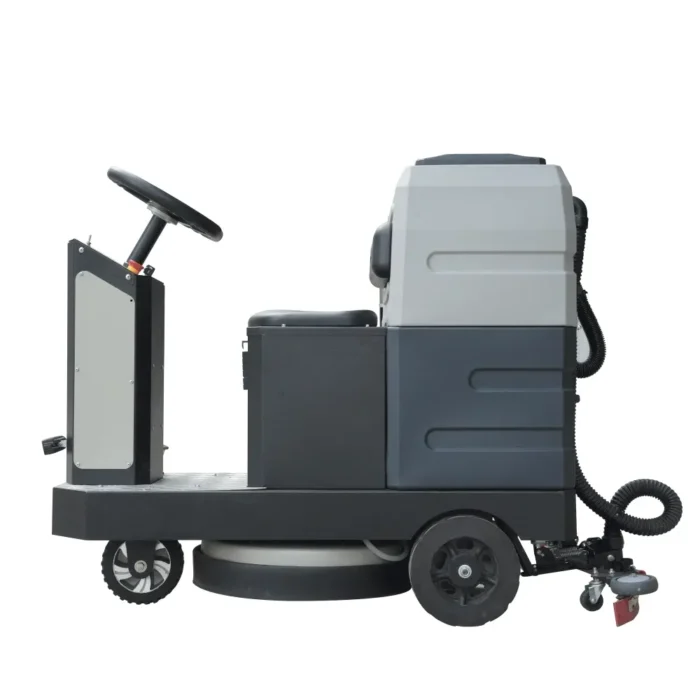 Cleaning efficiency and compliance standards are the uncompromising bottom lines for large-scale buildings. The V6 equipment integrates high-pressure spray, brush and vacuum recovery systems. The water flow can be precisely controlled between 5 and 20 liters per minute, ensuring that the cleaning agent concentration reaches the optimal decontamination ratio of 0.3%. After cleaning, the residual moisture on the ground can be controlled below 8%, and the drying time is shortened to less than 2 minutes. This is crucial for maintaining the safety of areas with hundreds of people per minute during peak hours. When responding to public health emergencies, its optional hot water cleaning function can operate at a temperature of 75°C, with an inactivation rate of over 99.5% for surface microorganisms, meeting the strict hygiene certification requirements. This quantifiable cleaning quality provides a stable and reliable compliance guarantee for large buildings.
From the perspective of operation management and technology integration, the facility management systems of modern large-scale buildings are evolving towards intelligence. An advanced indoor ride on scrubber machine is not only a cleaning tool but also a data node. The V6 model can be equipped with an iot module to upload real-time data such as the working area, battery power consumption, and water usage, with an accuracy error of less than 2%. Managers can thereby analyze the optimization space of the cleaning path and increase work efficiency by another 15%. In the face of the global trend of rising labor costs, this strategy of enhancing human efficiency through smart devices has become a clear trend in commercial real estate and public facility management. It transforms heavy physical labor into technology-driven tasks, enabling the cleaning team to focus more on handling detailed areas that machines cannot handle, thereby achieving a leap in overall cleaning standards. Therefore, for any large-scale building that pursues excellent operation, cost control and future adaptability, investing in such equipment has changed from an "optional" to a "must-have" strategic decision.
Cleaning efficiency and compliance standards are the uncompromising bottom lines for large-scale buildings. The V6 equipment integrates high-pressure spray, brush and vacuum recovery systems. The water flow can be precisely controlled between 5 and 20 liters per minute, ensuring that the cleaning agent concentration reaches the optimal decontamination ratio of 0.3%. After cleaning, the residual moisture on the ground can be controlled below 8%, and the drying time is shortened to less than 2 minutes. This is crucial for maintaining the safety of areas with hundreds of people per minute during peak hours. When responding to public health emergencies, its optional hot water cleaning function can operate at a temperature of 75°C, with an inactivation rate of over 99.5% for surface microorganisms, meeting the strict hygiene certification requirements. This quantifiable cleaning quality provides a stable and reliable compliance guarantee for large buildings.
From the perspective of operation management and technology integration, the facility management systems of modern large-scale buildings are evolving towards intelligence. An advanced indoor ride on scrubber machine is not only a cleaning tool but also a data node. The V6 model can be equipped with an iot module to upload real-time data such as the working area, battery power consumption, and water usage, with an accuracy error of less than 2%. Managers can thereby analyze the optimization space of the cleaning path and increase work efficiency by another 15%. In the face of the global trend of rising labor costs, this strategy of enhancing human efficiency through smart devices has become a clear trend in commercial real estate and public facility management. It transforms heavy physical labor into technology-driven tasks, enabling the cleaning team to focus more on handling detailed areas that machines cannot handle, thereby achieving a leap in overall cleaning standards. Therefore, for any large-scale building that pursues excellent operation, cost control and future adaptability, investing in such equipment has changed from an "optional" to a "must-have" strategic decision.
Cleaning efficiency and compliance standards are the uncompromising bottom lines for large-scale buildings. The V6 equipment integrates high-pressure spray, brush and vacuum recovery systems. The water flow can be precisely controlled between 5 and 20 liters per minute, ensuring that the cleaning agent concentration reaches the optimal decontamination ratio of 0.3%. After cleaning, the residual moisture on the ground can be controlled below 8%, and the drying time is shortened to less than 2 minutes. This is crucial for maintaining the safety of areas with hundreds of people per minute during peak hours. When responding to public health emergencies, its optional hot water cleaning function can operate at a temperature of 75°C, with an inactivation rate of over 99.5% for surface microorganisms, meeting the strict hygiene certification requirements. This quantifiable cleaning quality provides a stable and reliable compliance guarantee for large buildings.
From the perspective of operation management and technology integration, the facility management systems of modern large-scale buildings are evolving towards intelligence. An advanced indoor ride on scrubber machine is not only a cleaning tool but also a data node. The V6 model can be equipped with an iot module to upload real-time data such as the working area, battery power consumption, and water usage, with an accuracy error of less than 2%. Managers can thereby analyze the optimization space of the cleaning path and increase work efficiency by another 15%. In the face of the global trend of rising labor costs, this strategy of enhancing human efficiency through smart devices has become a clear trend in commercial real estate and public facility management. It transforms heavy physical labor into technology-driven tasks, enabling the cleaning team to focus more on handling detailed areas that machines cannot handle, thereby achieving a leap in overall cleaning standards. Therefore, for any large-scale building that pursues excellent operation, cost control and future adaptability, investing in such equipment has changed from an "optional" to a "must-have" strategic decision.
Limited Release · Spring 2024
Reserve the Current Drop