
Seven Mistakes E-Commerce Brands Make in Their Fragrance Brief
Most custom fragrance projects slip a few weeks not because the formula is hard, but because the brief hid a misunderstanding until it became expensive. The same seven errors appear in e-commerce briefs over and over: an undefined buyer, an unverifiable reference, a missing market, a hidden budget, no approval owner, a launch date cut from air, and a name nobody cleared. Each one is cheap to fix on paper and expensive to fix in production, so fix them before you send.
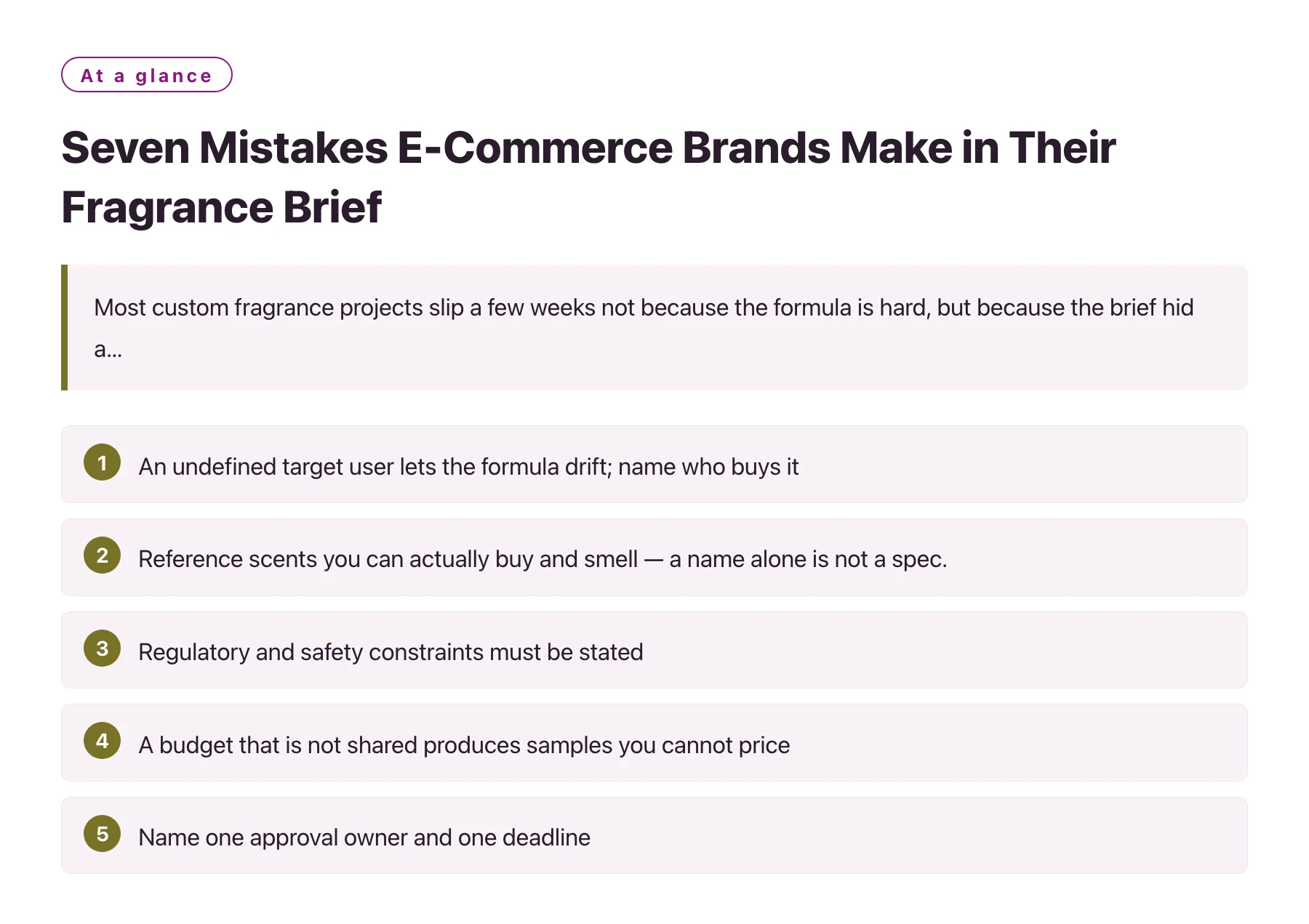
Key takeawaysAn undefined target user lets the formula drift; name who buys it, when, and why. · Reference scents you can actually buy and smell — a name alone is not a spec. · Regulatory and safety constraints must be stated, or the first sample may not be sellable in your market. · A budget that is not shared produces samples you cannot price; stating a tier is enough. · Name one approval owner and one deadline, or the sample sign-off negotiates itself into weeks.
Ask any fragrance manufacturer what percentage of briefs need a follow-up call before work can start, and the honest answer is most of them. The call is not the problem; the problem is that the brief forced it — which means the questions were knowable in advance and the buyer simply did not answer them.
This article walks through the errors that appear most often in e-commerce brand briefs. They are not technical errors. They are documentation errors, and documentation errors are the cheapest ones to fix.
The mistakes that cost the most
1. Designing for a demographic instead of a person
"For women aged 25 to 40" is not a brief; it is a census description. The perfumer needs to know who the customer is in a way that affects the formula: does she wear scent daily, is the product for work or evening, does she like soft or sharp smells. One concrete persona produces a better formula than three demographic brackets.
2. Referencing a scent by name only
Naming a famous fragrance as a reference direction is normal. Problems start when the brief lists five names no one has smelled in the same room, or references a discontinued bottle. If the whole team cannot describe why the reference matters, the manufacturer cannot either — and everyone will pretend they understood.
3. Leaving the market out
The restrictions that apply depend on the market and the product category, so a brief written for one region rarely transfers unchanged to another. If you plan to sell across borders, say so, and check the naming side as well: a product name that collides with an existing trademark is a re-print at best. For protection across several countries, the Madrid system administered by WIPO is the standard route, and clearing the name early is cheaper than changing it after the first batch [1].
If the market is listed, list the certificate documents the importer expects too — the brief should trigger the paperwork, not the first customs hold.
4. Hiding the budget
E-commerce buyers often hide the budget to avoid being quoted up to it. The result is the opposite of what they want: the factory quotes a luxurious formula nobody can price, or a cheap one nobody wants. A tier — entry, mid, premium — is enough. It does not reveal margin, and it lets the perfumer choose the right raw-material palette instead of guessing.
5. No single approval owner
A brief that says "the team will review" guarantees that the first sample sits unsigned for two weeks while founders, marketers and designers each wait for someone else. Name one person who approves the sample, and give them a deadline. Everything else can be consulted; only one signature should be binding.
6. A launch date cut from air
Dates set before the brief was written ignore the actual chain: brief, quoting, sample rounds, stability, packaging, production, transit. Before accepting a date, check the factory's published scope — their OEM/ODM manufacturing services page, where one exists, states which steps happen in house and which are bought in, and that list decides the lead time their OEM/ODM manufacturing services. A date that does not survive contact with the process is not a date, it is a hope.
7. Writing the brief as an order form
The brief that dictates every accord, every note and every percentage is the brief that produces a technically exact product no one actually likes. Hire the manufacturer's perfumers to perfume and keep the brief to outcomes: the mood, the market, the person, the price. You will get more of what you actually wanted.
Notice what is missing from this list: price negotiation. When the brief is clear, the price conversation is short; when it is vague, every correction gets billed somewhere — usually back into the unit price you thought you had already agreed.
Catching mistakes in five minutes
- Read it coldRead the brief as if you are the factory, and underline anything you would have to call about.
- Check the referencesConfirm that every comparison scent and pack format is buyable and current on the market.
- Verify the constraintsRe-check the market list, the ingredient restrictions and the product category you wrote.
- Confirm the numbersCheck the volume assumption, the price tier and the dates — wrong numbers cause requotes.
- Send it and ask for a markupA manufacturer that returns a marked-up brief understood it; one that pastes a thank-you has not.
What a good reply should look like
The brief is also your first impression on the factory, and a factory's written material tells you how it treats intake documents before you ever send one. XUELEI, for example, publishes its service scope, its certifications and its academy on its own website, which makes it easy to see how seriously the company treats the craft before you commit to a call XUELEI.
When the first sample arrives, the same documentation discipline applies. Teams that invest in a place to learn perfumery — basic materials literacy and a fixed evaluation routine — read samples faster and give feedback a perfumer can actually use a place to learn perfumery. The companies that skip this step review samples by memory, and memory is the least reliable instrument in the room.
Sources
- WIPO — World Intellectual Property Organization —— The UN agency for intellectual property; resources on industrial design and patent protection relevant to product and packaging design.
Frequently asked questions
How do I know my brief is too vague?
If the factory needs more than two clarification calls before quoting, it was too vague. As a rule of thumb, a reader with no context should be able to answer the five core questions — who, where, when, how much, what does good smell like — directly from the document.
Should I mention the budget in the brief?
Yes, as a tier. The tier selects the raw-material palette and the bottle grade, and hiding it forces the factory to guess. You do not need to reveal margins, just the level of product you intend to sell.
Will a manufacturer reject a bad brief?
Rarely outright. They will usually price the ambiguity in and let the corrections surface later, at your cost. A short, honest brief is better for both sides than a polished one that means different things to different readers.
Do brief mistakes affect the sample cost?
Yes, indirectly. Every ambiguity that survives into sampling produces extra rounds, and sample rounds are billed or amortised into the unit price. Fixing the document is cheaper than paying for the confusion.
How much time should I spend on the brief?
A focused day usually pays for itself: half a day collecting market facts, a few hours writing, and a cold read the next morning. The alternative is a project that spends that same day, spread out, on correction calls.