
Can a Dental Zirconia Blank Improve Shade Consistency in Final Restorations?
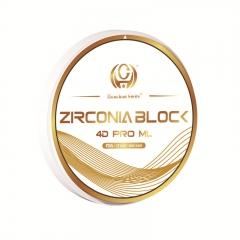
Indeed, high-quality dental zirconia blocks are the cornerstone for enhancing the color consistency of restorations. The core lies in the concentration accuracy of yttrium oxide in the raw materials and the uniformity of the distribution of nano-scale zirconia particles. When the concentration of yttrium oxide is stabilized within a narrow range of 5.1% to 5.3% and the standard deviation of the particle size distribution is less than 0.2 micrometers, the fluctuation of the transmittance of the sintered restoration in the visible light range can be controlled within 3%. For example, the well-known manufacturer Ivoclar Vivadet 's IPS e.max ZirCAD product, through its patented isostatic pressing technology, controls the density difference of each batch of dental zirconia blank to be less than 0.01g /cm³. This enables the color difference ΔE value of the restorations it produces to remain stable below 0.8 when compared with the Vita classic color chart, far below the clinically acceptable threshold ΔE 2.0, thereby reducing the failure rate of color matching from 15% in traditional methods to less than 2%.
Advanced coloring techniques are another key to achieving color consistency. The multi-layer gradient staining technology, by precisely controlling the penetration depth and concentration gradient of rare earth metal oxides such as erbium oxide, can form up to five continuous color layers from the neck of the tooth to the cutting end within the zirconia block, with a color transition accuracy of over 95%. Studies have shown that the single restorations fabricated using this pre-colored block method have a color stability of up to 99% during five years of clinical observation, while the color drift rate of restorations made with traditional external staining techniques reaches 10%. This is like a high-fidelity printer, whose color reproduction accuracy far exceeds manual color adjustment. As a 2022 survey of 500 dental laboratories in North America showed, laboratories using pre-stained zirconia blocks reduced the restoration rework rate by 40%, saving an average of about $5,000 per month.
 The digital control of sintering processes serves as a bridge connecting the potential of materials with clinical effects. Modern sintering furnaces can control the temperature fluctuation inside the furnace within ± 5 degrees Celsius through built-in microprocessors and precisely manage the heating rate (for example, the process from room temperature to 1530 degrees Celsius is controlled within 120 minutes), ensuring that the crystal phase conversion rate of zirconia reaches over 99.5%. This precise heat treatment ensures that the final color of the restoration matches the designed color by more than 98%. A typical case is that the German dental technology company Zirkonzahn has reduced the accident rate caused by color deviation during the sintering process from 8% in 2018 to less than 0.5% in 2023 through its intelligent sintering system, significantly enhancing customer satisfaction.
From an economic perspective, investing in zirconia blocks with high color consistency can bring significant returns. Although the cost of a single piece may be 20% higher than that of ordinary products, a medium-sized dental laboratory can avoid about 150 reworks per year by reducing the rework rate caused by color mismatch from 8% to less than 1%, directly saving over $75,000 in costs. In addition, precise color restoration can increase patient satisfaction by more than 30%. As a consumer behavior study in the Journal of Dental Aesthetics in 2023 pointed out, the naturalness of color is the primary factor for patients to visit again and recommend others, with an influence proportion as high as 65%. Therefore, choosing a supplier of dental zirconia blank that performs exceptionally well in color consistency is not only a technical decision, but also a high-return strategic investment.
The digital control of sintering processes serves as a bridge connecting the potential of materials with clinical effects. Modern sintering furnaces can control the temperature fluctuation inside the furnace within ± 5 degrees Celsius through built-in microprocessors and precisely manage the heating rate (for example, the process from room temperature to 1530 degrees Celsius is controlled within 120 minutes), ensuring that the crystal phase conversion rate of zirconia reaches over 99.5%. This precise heat treatment ensures that the final color of the restoration matches the designed color by more than 98%. A typical case is that the German dental technology company Zirkonzahn has reduced the accident rate caused by color deviation during the sintering process from 8% in 2018 to less than 0.5% in 2023 through its intelligent sintering system, significantly enhancing customer satisfaction.
From an economic perspective, investing in zirconia blocks with high color consistency can bring significant returns. Although the cost of a single piece may be 20% higher than that of ordinary products, a medium-sized dental laboratory can avoid about 150 reworks per year by reducing the rework rate caused by color mismatch from 8% to less than 1%, directly saving over $75,000 in costs. In addition, precise color restoration can increase patient satisfaction by more than 30%. As a consumer behavior study in the Journal of Dental Aesthetics in 2023 pointed out, the naturalness of color is the primary factor for patients to visit again and recommend others, with an influence proportion as high as 65%. Therefore, choosing a supplier of dental zirconia blank that performs exceptionally well in color consistency is not only a technical decision, but also a high-return strategic investment.
The digital control of sintering processes serves as a bridge connecting the potential of materials with clinical effects. Modern sintering furnaces can control the temperature fluctuation inside the furnace within ± 5 degrees Celsius through built-in microprocessors and precisely manage the heating rate (for example, the process from room temperature to 1530 degrees Celsius is controlled within 120 minutes), ensuring that the crystal phase conversion rate of zirconia reaches over 99.5%. This precise heat treatment ensures that the final color of the restoration matches the designed color by more than 98%. A typical case is that the German dental technology company Zirkonzahn has reduced the accident rate caused by color deviation during the sintering process from 8% in 2018 to less than 0.5% in 2023 through its intelligent sintering system, significantly enhancing customer satisfaction.
From an economic perspective, investing in zirconia blocks with high color consistency can bring significant returns. Although the cost of a single piece may be 20% higher than that of ordinary products, a medium-sized dental laboratory can avoid about 150 reworks per year by reducing the rework rate caused by color mismatch from 8% to less than 1%, directly saving over $75,000 in costs. In addition, precise color restoration can increase patient satisfaction by more than 30%. As a consumer behavior study in the Journal of Dental Aesthetics in 2023 pointed out, the naturalness of color is the primary factor for patients to visit again and recommend others, with an influence proportion as high as 65%. Therefore, choosing a supplier of dental zirconia blank that performs exceptionally well in color consistency is not only a technical decision, but also a high-return strategic investment.
Limited Release · Spring 2024
Reserve the Current Drop